

About Robins
Who better to tell us all about robins than Ruby Robin herself?
Hi! I am Ruby Robin!
National Robin Day really isn’t just about me, or in fact just Robins. National Robin Day is about helping all of us…… me, other songbirds and all my wildlife friends get through the toughest time of the year.
Saying that, I have lots of interesting things to tell you about robins….. no wonder we are the nations favourite bird!
We’re famous!
Authors from Chaucer to Shakespeare, William Blake to Enid Blyton, and Thomas Hardy to Ted Hughes, have written about robins. They also feature in the well-known (and rather grisly) children’s tale Babes In The Wood and nursery rhyme Who Killed Cock Robin?
We are so well liked, four professional football clubs — Bristol City, Charlton Athletic, Cheltenham and Swindon Town — are nicknamed ‘The Robins’ and all play in red kits!
A familiar name
In the 17th century it was popular to give myself and some of my friends, human names. I’m sure many of you know some of them….. Jenny Wren, Jack Daw and Tom Tit! Us robins were then known as Robert Red Breast. Over time I became Robin. I really do think that my human name helps strike up the wonderful friendship we have!
Don’t be mad!
My so called ‘red breast’ is actually orange! I know…..a robin that’s actually admitted it…. Shock, horror!! You see, Orange wasn’t recognised as a named colour in English until the 16th century when fruit of the same name started to be imported. So red was as close as anyone could get.
Thank you Sheilagh Adams for your picture showing my glowing orange breast so well!

A gardener’s best friend
This is so true! Myself and my friends, feathered or not are absolutely your best friends. We appreciate all that you do for us in your gardens, especially in these winter months.
Us robins are known for being that tame little bird, the one that will hop along, following your garden fork for worms. We will perch close by and await the crumbs of your lunch.
I’ve heard some of my friends saying that this echoes ancestral behaviour of robins following wild boar through their woodland habitat, searching for food in the upturned soil. I’m happy to go with the ‘gardeners best friend’ bit though!
Thank you Joshua Cook for sharing your lunch with me the other day! I was more than happy to pose for a photo on your foot in return!


Stormy Weather
Perhaps not so commonly known, Thor, the Norse god of thunder was reputedly fond of the colour red. Hence the robin came to symbolise the coming of stormy weather.
It’s not the only time that our fiery breast colouring has been linked with prediction. In Celtic mythology, the killing of a robin would be sure to bring death or loss by a blaze.
Christmas
This one is a favourite of mine. I am so honoured to be such a big part of your Christmas celebrations!
So the story goes back to Victorian times, where the tradition of sending Christmas cards started. Postmen wore bright red jackets and this earned them the nickname of 'Robins' or ‘Redbreast’.
It was common for artists to illustrate Christmas cards with pictures relating to the delivery of letters, such as post-boxes or the postmen known as robins.
Eventually, this evolved into the artists drawing the robin delivering letters too! I for one, love that this symbol has stayed with us ever since.
Another sweet tale is the story of the little brown bird who helped to protect the face of the baby Jesus from the flames of the hearth in the manger. The fire scorched the little bird whose breast was forever thereafter red as a mark of its kind heart.

When robins appear, loved ones are near
I’ve saved the best till last! Us robins are very fond of this one.
The well-known phrase, 'When robins appear, loved ones are near', alludes to the belief that the robin is a messenger.
When robins are seen, some people take comfort that loved ones are at peace, and many believe that their lost loved ones are visiting them.
With everything that’s happened in the world over that last couple of years, you and I both know how nature has been a comfort to so many and I really want to end by saying it works both ways….. you take care of us, and we’ll take care of you.
Whatever beliefs people hold dear, it is impossible to deny the rich symbolism of the robin.


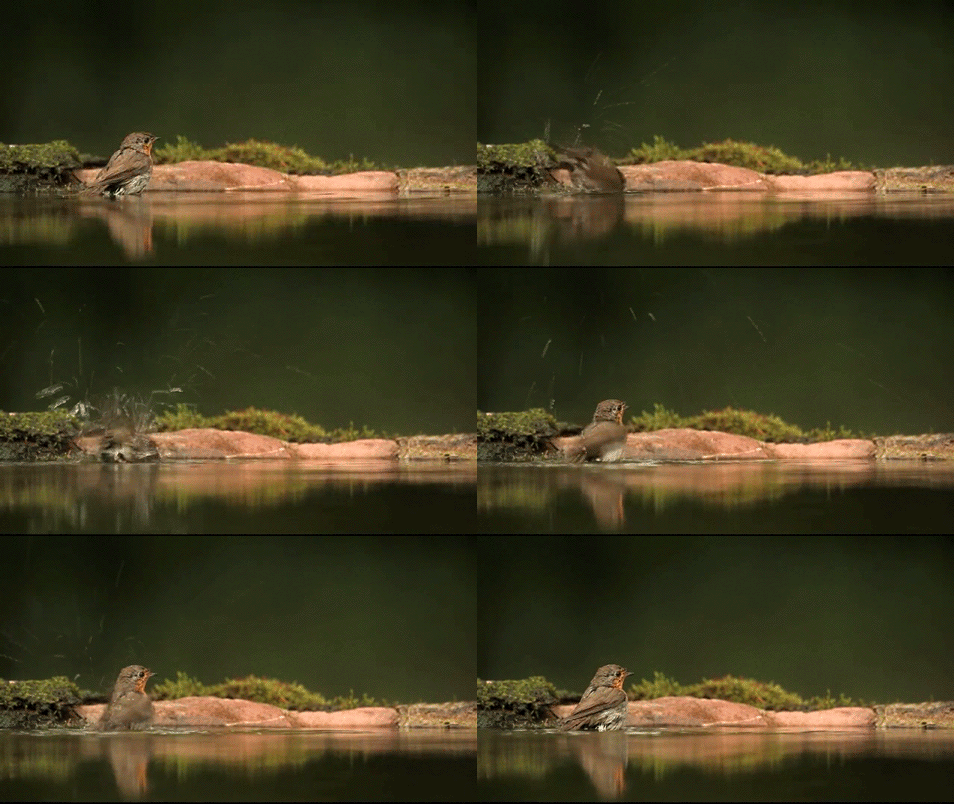

The European Robin
Erithacus rubecula)
Perhaps the best-known of all British birds and a common visitor to our gardens.
British affection for the robin was cemented in the 1960s when it was adopted as the UK's favourite bird. In 2015, the robin scooped the title of Britain's National Bird in a poll organised by naturalist David Lindo.
Did you know?
-
Male and female robins look identical
-
Both male and female birds sing - they have a different song in the autumn from the spring.
-
Robins are very territorial - most territories are held by males.
-
They use their song to defend their territory - the beautiful the song, the stronger the territory!
-
Baby robins are spotty brown in colour to merge with the background in defence of predators.
-
Fledglings get their red colour by autumn when they start to learn the autumn song.
-
Robins build their nests very quickly - one man reported hanging his jacket on a shed door to do some gardening, when he returned an hour later, a robin was nesting in the pocket!
-
Robins make their nests in any suitable depression in an open nest.
-
If you want to help by offering a nesting site then an old teapot hung up is perfect!

Fascinating facts
Male and female robins are virtually identical in appearance with an instantly-recognisable 'red breast' and face. They also have a distinctive and beautiful song. During the breeding season, the ‘spring song’ is fluting and warbling, but turns more plaintive in their ‘autumn song’.
The average lifespan of the robin is two years, although nearly three-quarters of British birds die before they are one year old, either the victim of predators or unable to fend for themselves. Fiercely territorial, only one robin will occupy a territory unless it has a mate. Consequently, 10% of older robins die defending their territory.
Robins are not too particular about food when their usual diet of spiders, worms, caterpillars and insects are scarce in winter and will eat just about anything put out on a bird table, especially fatty foods such as unsalted bacon rind and cheese.
They usually only pair up for the breeding season, from March to June in Britain, and build a cup-shaped nest made from moss, grass and leaves, lined with hair and feathers.
Like their eating habits, robins are just as unfussy about nesting sites; which have been known to include barbecues, watering cans, wellington boots, flower pots and even post boxes and coat pockets!
Both parents take responsibility for feeding and looking after their young who fly the nest after a couple of weeks. Juveniles are a rather dull, spotty brown colour and it takes two to three months for them to sprout orange feathers under their chin and a similar period again for this patch to extend to complete the adult appearance.

Robins are special to us

"This lovely Robin is quite special to me, people say they are spiritual animals and I have to agree.
Last winter I was struggling quite bad with my mental health and
my anxiety was peaking, I left the job I was on up in Bellingham Northumberland to catch a breather and go for a head spacewalk, I fancied the waterfall so made my way to the gates.
Just before I reached them this little beauty was dancing around above me, I stopped and just watched as it flew around my head, it eventually stopped and landed on the gate post as if to say 'come in'
I had my camera in hand so grabbed a few shots. As I did, it seemed to take a Bow ( which is what I captured)
I walked to the waterfall after witnessing this amazing bird and it followed me all the way to the end, we shared my lunch when we got there and it cleared my head so much, this little picture represents so much for me."
Picture and story courtesy of Ian Sproat who entered our what3birds? Photography Competition in 2021
We are special to Robins
"Outside my back door is a huge old yew tree, in a cavity of whose trunk a pair of robins build their nest every year. My closed French doors give my cat, Aslan, and I a ringside view of the robins busily ferrying in ‘bits of twine and twig’, launching off the back of my garden chair up through the ivy into their hidden den.
When the chicks are ready to fledge, Aslan can’t resist them as they hop amongst the undergrowth, so he is confined to quarters as soon as I’m aware the fledglings are out of the nest.
One year, however, my timing wasn’t quite right, and one evening when my partner and I were cuddled up on the sofa, Aslan carefully placed at our feet a fledgling robin. It was paralyzed by fear but apparently unharmed, so we put it in a shoebox with tissue paper nest overnight, wondering what to do.

I decided to create a robin nursery in the Aslan-free living room. In a squirrel trap I made a pseudo nest in a small box, with a saucer of water, some bird seed, and worm-laden compost, though the chick showed no interest in the latter. The chick was happy to make its home in the cage, and could fly through the mesh around the room.
The first day it couldn’t fly far, with only a short stump where its tail should be. Over the next two days its feathers grew fast and it flew higher and higher. On the third day it could fly perfectly well, so I cornered it, trapped it in a container, took it outside and was delighted to see it fly straight up to the top of the garden wall.
The cacophony of the robin family singing for the rest of the afternoon told me the parents were overjoyed, and no doubt amazed, to see their offspring again!"
Story sent in from SBS member, Alison Spottiswoode
Picture by Mark Shorting
Why do Ruby and her friends need your help?

Nature brings us all so many benefits. From the beautiful birdsong we hear when we wake up in the morning, to the trees that clean the air we breathe, the wonders of nature are all around us. But sometimes we take these for granted.
Our birdlife is suffering. In the last 40 years tree sparrow numbers have fallen by a drastic 96%, willow tits are down by 92% and the beautiful singing skylark has dropped by 63%. We can’t afford to ignore these and many more worrying statistics.
What would Christmas be without our favourite national bird, the robin?
National Robin Day was born to inspire collective action to help save our garden birds. By being part of National Robin Day, you can join with thousands of bird lovers across the UK to celebrate Britain’s favourite bird and help protect our wildlife for future generations.
Why not share a little joy this Christmas with your feathered friends?
Every bird feeder made, nest box put up and every penny raised will help save Ruby Robin and her friends.


Join our mailing list to get robin tips as well as wildlife and charity news updates direct to your inbox!
#NationalRobinDay is a campaign to raise awareness of the challenges our birds and wildlife face each winter, and how we can all help: it doesn't matter how big or small your outdoor space is, we ALL have the power to help our birds and wildlife through the harsh winter months.
